


When I started kicking the tires on the idea of opening a shop in 2018—in spite of a lifetime of hearing, “you can’t make any money doing that”—I did the smart thing and connected with consultants from SCORE first. Both retired executives I spoke to had extensive retail backgrounds, so I figured they would have the secret formula for retail success. Our conversations focused on inventory, margins, and product-market fit—typical MBA stuff—but I never felt like these business wizards could answer the simple question of whether or not I had a chance at making it.
The Goldman Sachs 10,000 Small Businesses program wasn’t much different—twelve weeks dedicated to small enterprise success, yet I was one of only a few Main Street retail businesses in my cohort, and there was no secret formula given there, either.
People really do act like the make-or-break markers of success in independent retail rely on the prospective business owner to “get it right.” I know this sounds counterintuitive, but success isn’t decided by whether or not someone’s idea is good enough or the area has sufficient foot traffic to support it. Our understanding of what makes independent retail successful is dangerously outdated.
The thing no one told me—not SCORE, not Goldman—is that Main Street retail has never really been an income business. It’s actually a real estate acquisition tool. The people who made it work historically owned their buildings. Once you understand that, you understand that no matter how well a shop is connecting with its community, the revenue required to make rent and pay people a living wage, is almost entirely out of reach, not because ideas don’t connect, but because cost of living increases and commercial rents have grown out of proportion with sales. Without the underlying mechanism of real estate ownership, the visible, everyday economics don’t pencil out.
In this post we’re going to look at the visible math before we look at the real estate engine, because the visible math without owning the real estate is what the majority of business owners are working with today.
I’m going to do some simple math using what the average retail business in America generates in revenue, combining that with average cost per square foot on retail space, to see if what’s left could pay for everything else and pay the workers a living wage.
I know in my rented space on South Tacoma Way the math doesn’t work, but I thought: what if we applied this simple formula to national averages that are widely available? Then will people understand that running an independent retail or food business is no longer viable?
By “viable” I mean a way for an average person to make enough money to pay their bills and feed their families.
Building our numbers
First let’s examine what an average storefront retail business in the United States makes and what cost ratio targets should be.
Annual gross revenue of average retail Main Street business: $300,000 [source]
Average price per square foot of commercial retail space: $24.69 [2023, source]
Occupancy cost target for retail businesses: 5-10% of gross revenue [source]
Payroll target cost for retail businesses: 30% of gross revenue—ideally less [source]
Based on these numbers alone, which are averages and target ratios, a retail business in a 1,500 square foot space won’t work.
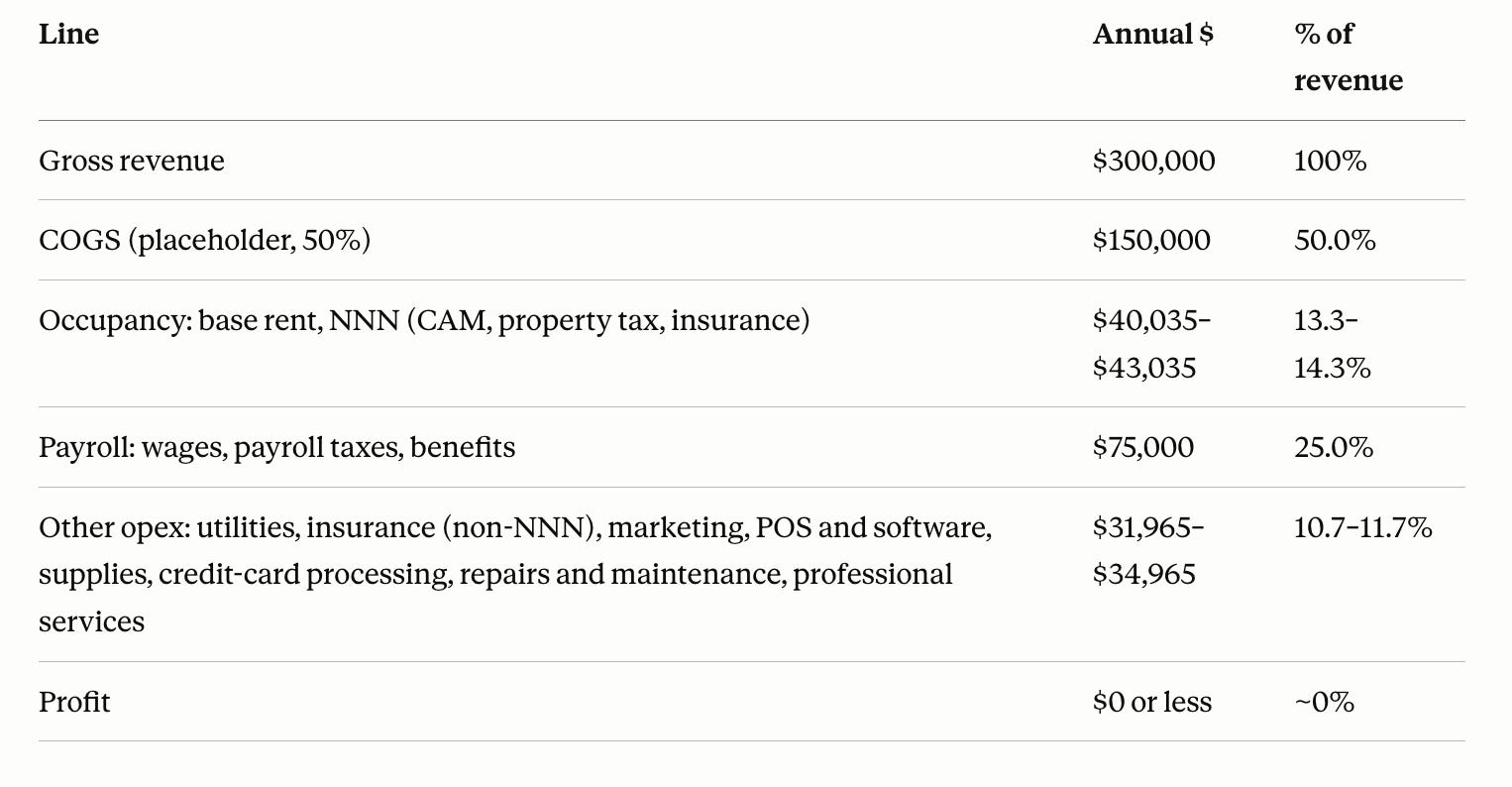
At the average retail price per square foot ($24.69), a 1,500 square foot space runs $37,035 per year without factoring in NNN or other occupancy costs, which already exceeds the target 10% ratio.
Cost of goods is typically 50% in specialty retail, which leaves little room for operational costs: $2,800 per month to cover insurance, taxes, supplies, legal, accounting, software, hardware, marketing, etc.
But the headline really is that our total payroll budget for all employees is $75,000, including taxes and benefits—targeting 25% of total revenue to stay under the recommended 30 percent.
$75,000 isn’t enough to cover a reasonable salary for one person living as single head of household in most American cities, let alone someone with children. You can also observe that in this scenario, there is no money left over for profit—so the shop owner doesn’t take anything extra home.
Granted, $75,000 is probably enough for someone in a dual-income household to earn running a retail shop, but that means we are limiting who gets to run businesses in our town to people who have external support. It also means someone running a retail shop relies on external support over which they have little to no control in order for it to continue to make sense for them to stay in business.
When this happens to teachers, nurses, and social workers, we don’t always fix the problem immediately, but we recognize it’s there. For small business owners, not even the community organizations lending us money or resources seem to understand these financial realities.
Certainly no one at SCORE laid out these ratios for me.
What would it take to make a living wage?
What if we start with a living wage and work backwards? Can we do that?
Take my hometown of Grand Rapids, Michigan. In Kent County, a living wage for a single adult with one child is $82,123. If we use $82,123 as the dollar amount to work from in our payroll line, a storefront retail business will have to make $328,492 annually to support an adult living with 1 child in Kent County—where that salary ($82,123) comprises 25% of gross revenue.
Realistically for that person to actually earn $82,123 gross, the payroll budget has to be more—to include taxes, insurance, and benefits. That pushes the required revenue closer to $370,000.
Keep in mind that payroll budget is just enough for one person to live reasonably as single head of household, so that means every transaction in that $370,000 is processed by one person. That’s 7,400 transactions per year at an average of $50 each—nearly 20 transactions per day if you’re open 30 days per month. But you can’t really be open 30 days each month if you’re the only employee, can you? So cut that to 5 days per week. Now you have to process at least 30 transactions at $50 per transaction every single day you’re open.
That volume is not likely. We’ll get into why in a minute.
Adding part-time coverage so you can take a vacation
What if you want to take a vacation, or get sick? You have to hire someone part-time to cover shifts. Minimum wage in Kent County is $13.73—just $6.06 above the poverty wage.
You could afford to continue to pay yourself a living wage and hire a part-time employee for 20 hours per week at minimum wage, but only if the shop revenue increases to $433,000, because now total payroll with taxes and insurance balloons to $108,000 (25% of total revenue).
At $433,000 you’re processing around 24 fifty-dollar transactions 7 days per week, which is a lot. To give you something to compare against, in the past year, Fernseed averaged 24 transactions per day with a $47.52 AOV, and that includes both in-store and online. To comfortably process that many orders, and the high-touch customer service that is expected to accompany it, we need at least 3 people working 7 days a week. Each of those people needs to know how to operate the cash register, check the customer service email, answer questions and take orders over the phone, implement our return policy, and they need to possess fairly in-depth product knowledge on plant care and flowers—including making bouquets. That’s not a minimum wage job.
What if rent were cheaper?
Let’s jump back to Kent County for a minute and run an experiment.
What if every other line item—COGS, operational costs—stayed the same on $433,000 in gross revenue, but we dropped occupancy to $12 per square foot on the same 1,500 square foot space? What would that free up?
The rent savings is $19,035 annually.
Our first model paid the part-time person Kent County minimum wage, $13.73 per hour, while an actual living wage in Kent County for a single adult with no kids is $24.34 per hour. If we use $12,100 of that rent savings, we can now pay the part-timer a living wage for the same 20 hours a week. That still leaves about $7,000 to offer the full-time employee or add some part-time hours for a third person—which would add coverage for breaks, days off, and illness.
Of course commercial rents haven’t been at $12 per square foot since probably… the 1990s? So that’s a pipe dream. But maybe worth saying there are commercial landlords who don’t charge market rate because they understand the math, want their tenants to be successful, and don’t need to maximize revenue on a property because they’re not leveraging the income from it to borrow more money to acquire more property. The tenants in buildings like these often have lease terms that leave room for shop owners to pay themselves. Community organizations could foster these below-market rent relationships by making connections like these stronger or subsidizing them.
The revenue needed to pay 2 people a living wage
Realistically you need at least two people to run a retail shop. So now let’s examine what a 1,500 square foot store would have to gross in order to pay 1 full-time and 1 part-time person a living wage.
I’m going to calculate an average living wage by combining 3 counties I’ve lived in— Kent (Michigan), Cook (Illinois), and Pierce (Washington)—plus Lewis County (Washington), where we are opening the second Fernseed location.
Living Wage Average Between 4 Counties
Living wage for a full-time owner/manager (single + 1 child): $87,595 annual gross (cost to business with add-ons: $98,632)
Living wage for a part-time retail associate (single, no children): $24.19 hourly, annual gross at 20 hours per week = $25,150 (cost to business with add-ons: $27,668)
So the total weighted payroll costs for these two in the average of 4 counties are $126,300. Let’s take a look at how that fits into a retail shop with average ratios and a locked-in rate of $24.69 per square foot for 1,500 square feet.
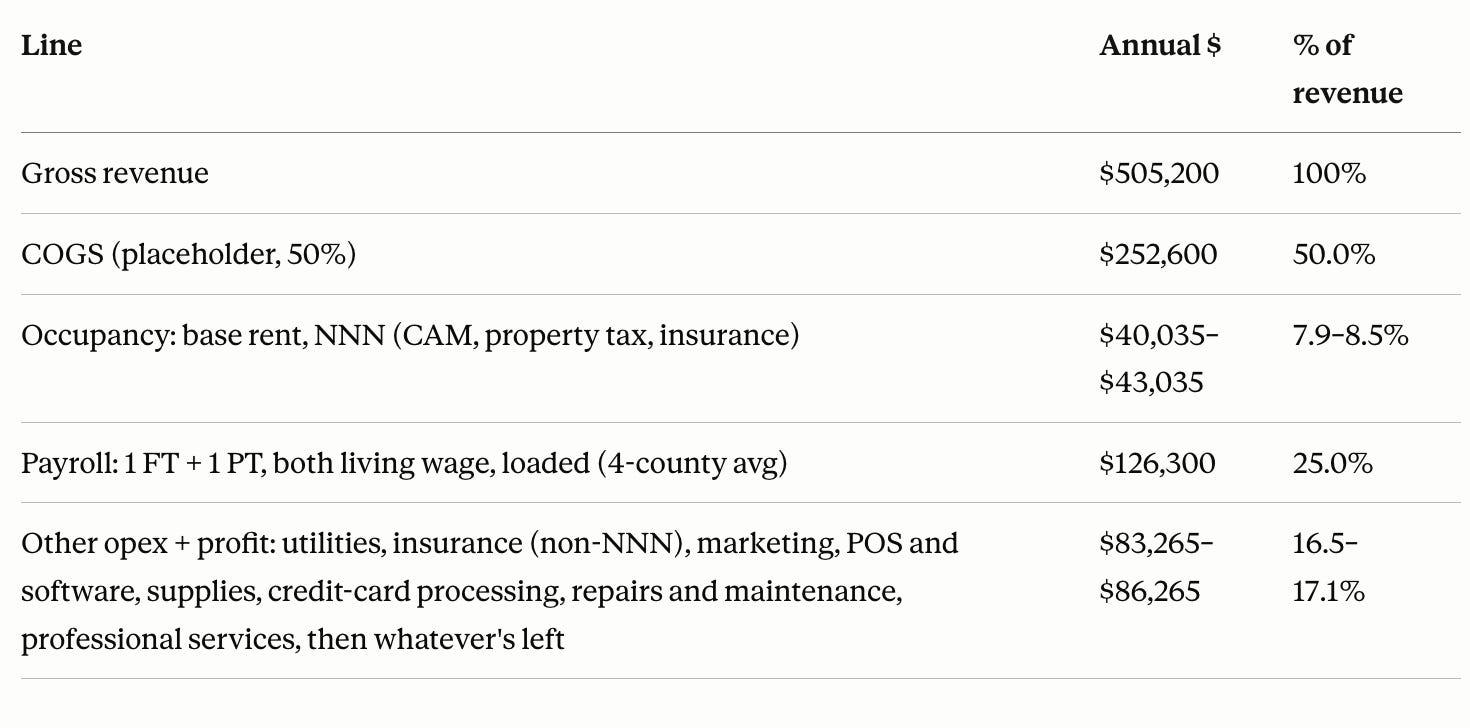
In order to pay 1 full-time and 1 part-time employee a living wage, the business must gross over a half million dollars in annual revenue.
From the Spring 2025 Main Street survey, we know that less than a quarter (23%) of businesses surveyed generated that much.
This is why so many business owners in the same Main Street survey reported not paying themselves what would be considered a living wage in their community, or asking friends and family to work for free in the business.
This makes retiring difficult
Paying yourself a living wage means covering your basic expenses, but not eating out, going on vacation, or—importantly—saving for retirement. So even at these stretch numbers, with shops making $500,000 in revenue, the person running it full time won’t be able to retire on their salary alone—and their salary, when you consider what tiny amount of profit is left over, is probably all they’re taking home.
Not to mention the start-up costs
Let’s also not forget that just to have the opportunity to make this kind of money, you first have to freeze 25-33% of your projected annual revenue into startup costs. Conservatively a shop making $500,000 would need $125,000 in opening inventory, equipment, supplies and tenant improvements.
Does someone with $125,000 of free capital to invest sink it into a concept that will hardly pay them a living wage, block them from saving for retirement, and makes the return on that upfront investment unlikely?
The only evidence you need
Maybe the only evidence you need that this system is broken is that people with an extra $125,000 to invest somewhere never invest it in Main Street businesses. Not unless they have an almost philanthropic drive, an obsessive hobby they want an excuse to use as a tax write-off, and a lot of free time. People with wealth invest it in the stock market, businesses that scale for big returns, or real estate.
Okay but hold on. What if you combined investing in real estate with an excuse to write-off a hobby? What if you could turn your passion—for model trains, flowers, tarantulas, organic food, knife sharpening, coffee, guitar pedals, eyelash extensions, whatever!—into a business that made enough money that you could: pay the mortgage on a commercial building; replace half the income you made working full-time for someone else; and write off all the supplies and gear and toys you’d buy anyway? Then would it be worth it?
Probably.
Ladies and gentlemen, boys and girls, this is how and why people used to justify starting, and continuing to own, Main Street retail and food businesses.
But the folks at SCORE didn’t explain this. Those retired executives had only worked for Fortune 500 companies or big businesses that scaled. They weren’t some old Greek dude from Chicago who’d understood the real formula since 1931—that if you want to do this, you should own the building. Don’t expect to make a lot in income, but expect to write off a lot of personal expenses to make up for it. Probably rent the upstairs apartment or the other storefront in the building—better if it’s both—until you can afford to move into it yourself, or have your kids move into it to save them money. But also probably have the kids work in the business for free.
I’m not saying this was the ideal formula, but I’m saying it was the formula for centuries before banks deregulated and real estate investors took over everything. Now we have the illusion that a Main Street business can still exist, because people still attempt them in rented spaces with little to no upside. But the economic reality is pretty dire. You can’t make any money doing this.
I should have listened to everyone who told me that.
I’m not the only one figuring out The Math Doesn’t Work. The drain that big finance and commercial real estate investing is putting on our communities is impacting everyone. It’s just that no one is studying it. No one is talking about it. No one is going back through the raw numbers and first person accounts and compiling them into a picture that answers 3 questions:
How did Main Street businesses historically function, economically?
Has that changed?
If it has changed, when did it change—and can we point to why?
If we don’t seek to understand this, in a couple decades, we won’t have cool things that set our town and cities apart from all the other towns and cities that also have an Applebee’s.
Is anyone studying this?
I suspect, as you may already know, that in the past more Main Street business owners owned their buildings. It was easier to own buildings because 1990s deregulation hadn’t happened yet. This also takes research on an almost parcel-by-parcel level, but when I dabbled in it last fall I found this to be almost shockingly the case in our stretch of South Tacoma Way where Fernseed is. Check out slides 31 & 32 in my PLACES Conference presentation for evidence.
I have never found a single longitudinal study that points to the trends in building ownership among Main Street business owners, nor have I found any organization collecting historic P&Ls that would provide real insight into the economics that drove the businesses powering the places we live. That’s not to say these things don’t exist, it just takes someone to track them down.
In all my conversations over nearly 3 years now looking at this, I’ve never found anyone doing that.
This is what I have found in NYC, where rents are insane. Yes, there might be more foot traffic, but not always. I wrote about this a while back and found that some businesses use their storefront almost as "marketing" and have a backend businesses (not just ecommerce). I write a newsletter about the survival of independent businesses in NYC, can I link to your post? I will give you full credit of course! Thanks for the illuminating information.
I might have mentioned this on another of your (excellent) posts, but the #1 predictor of if a restaurant will last longer than 3 years is if the proprietor/chef owns the building.